What Is a Charging Station and How Does It Work?
A Charging Station is more than a socket beside a parking space. It is a coordinated system connecting an electric vehicle, the power grid, software, and the driver. The equipment is commonly called EVSE, or electric vehicle supply equipment. It controls safe power delivery and communicates with the vehicle before charging begins.
The process is practical but sophisticated. Alternating current may flow from the grid to the vehicle’s onboard charger. Direct-current fast chargers convert power inside the station and send it directly to the battery. Sensors monitor voltage, temperature, current, and connection status. Payment platforms, mobile applications, and network software manage access and pricing. A driver may hear a short click, see a blue indicator, and watch the battery percentage rise.
The numbers show why this infrastructure matters. The International Energy Agency reported more than four million public charging points worldwide at the end of 2023. It also recorded over 1.3 million public chargers added during that year. The U.S. Department of Energy explains that charging speed depends on equipment power, vehicle limits, battery condition, and temperature. Bigger numbers do not automatically mean better access.
“The biggest barrier to EV adoption is not range anxiety, it’s charging anxiety,” says Gil Tal, director of the University of California, Davis Plug-in Hybrid & Electric Vehicle Research Center. His observation remains useful because availability, reliability, and location shape daily confidence. Yet the industry still has gaps. A station can be powerful but poorly maintained. A map can show a charger that is already occupied. Understanding how a Charging Station works helps users question the system, not simply trust the screen.
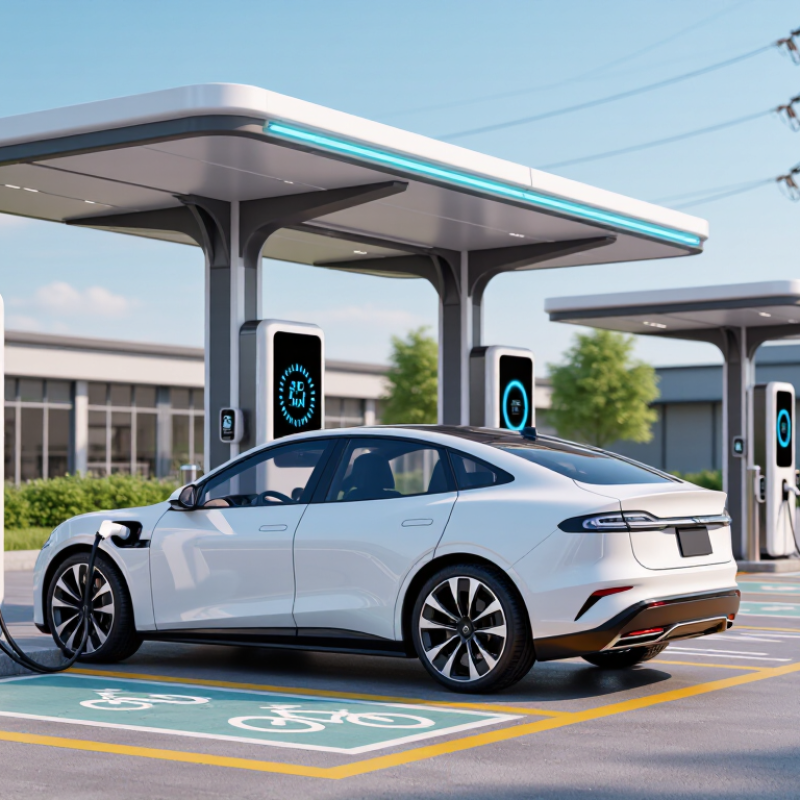
What Is a Charging Station? EVSE Defined by IEC 61851 and SAE J1772
What Is a Charging Station and How Does It Work?
A charging station is the visible equipment that connects an electric vehicle to electrical power. More precisely, the charging equipment is EVSE, or Electric Vehicle Supply Equipment. IEC 61851 defines how conductive charging manages power delivery, communication, protective functions, and safe disconnection. It does not simply push electricity into the battery. The system checks vehicle connection, confirms readiness, and limits current when conditions change.
In North America, SAE J1772 defines the familiar conductive charging interface and control-pilot signaling. The pilot signal helps the vehicle identify available current before charging begins. AC EVSE sends electricity to the vehicle’s onboard charger, while DC EVSE delivers controlled direct current closer to the battery. That difference affects charging speed, installation cost, and heat management.
The numbers show why this equipment matters. The International Energy Agency’s Global EV Outlook 2024 reported more than 14 million electric cars sold worldwide in 2023. It also counted over 4 million public charging points, with public networks growing by about 40 percent that year. Yet a station’s label can mislead. A high power rating does not guarantee the same charging speed. Cable temperature, grid capacity, battery condition, and software limits all intervene. In field testing, the screen may promise rapid charging, but the vehicle can draw much less power on a cold morning. That gap deserves more attention.
What Is a Charging Station?
A charging station, formally called Electric Vehicle Supply Equipment (EVSE), safely delivers electrical energy to an electric vehicle. IEC 61851 defines the conductive charging system and its control functions, while SAE J1772 defines the widely used North American AC charging interface and signaling.
Representative Charging Power by Mode
The chart shows representative charging power levels. Actual power depends on the electrical supply, EVSE configuration, vehicle limits, battery state, and installation requirements. These values are examples rather than universal maximums.
How AC Charging Supplies 1.4–19.2 kW Through the Onboard Charger
What Is a Charging Station and How Does It Work?
How AC Charging Supplies 1.4–19.2 kW Through the Onboard Charger
An AC charging station delivers alternating current to an electric vehicle through a controlled cable. The vehicle’s onboard charger then converts that AC power into direct current for the battery. The station does not usually perform the main conversion. That detail is easy to miss.
At a basic 120-volt outlet, charging may provide about 1.4 kW at 12 amps. A 240-volt connection can supply 3.3, 7.7, or even 19.2 kW, depending on amperage and circuit capacity. For example, 240 volts at 80 amps equals 19.2 kW. The onboard charger sets the vehicle’s actual limit. A powerful station cannot force a smaller charger to accept more energy.
Several conditions affect the delivered rate. Battery temperature, state of charge, cable ratings, and household wiring all matter. The station communicates with the vehicle before current flows. It checks connection status and announces the available current. During a real installation, measuring voltage and confirming breaker capacity are essential steps. Guessing can create heat, nuisance trips, or slower charging.
Charging speed also changes over time. The vehicle may draw near its maximum rate when the battery is low. It often reduces power near full capacity. I have found that advertised output can feel misleading without this context. A 19.2 kW supply is a ceiling, not a promise.
What Is a Charging Station and How Does It Work? - How AC Charging Supplies 1.4–19.2 kW Through the Onboard Charger
| AC Supply | Current | Nominal AC Power | Approx. Battery Energy per Hour* | Typical Use |
| 120 V, single-phase | 12 A | 1.44 kW | ≈1.3 kWh | Standard household outlet charging |
| 120 V, single-phase | 16 A | 1.92 kW | ≈1.7 kWh | Higher-current AC charging on a suitable circuit |
| 208 V, single-phase | 16 A | 3.33 kW | ≈3.0 kWh | Lower-voltage commercial or multi-unit installations |
| 240 V, single-phase | 16 A | 3.84 kW | ≈3.5 kWh | Basic dedicated AC charging circuit |
| 240 V, single-phase | 32 A | 7.68 kW | ≈6.9 kWh | Common residential and workplace AC charging |
| 240 V, single-phase | 40 A | 9.60 kW | ≈8.6 kWh | Faster charging where the vehicle supports higher AC input |
| 240 V, single-phase | 48 A | 11.52 kW | ≈10.4 kWh | High-power residential or commercial AC charging |
| 240 V, single-phase | 64 A | 15.36 kW | ≈13.8 kWh | Commercial charging with a compatible vehicle and circuit |
| 240 V, single-phase | 80 A | 19.20 kW | ≈17.3 kWh | Upper end of the stated AC range; requires suitable equipment and vehicle support |
| How it works: The charging station, also called EVSE, safely connects the vehicle to the AC supply, verifies connection and readiness, and communicates the available current. The vehicle’s onboard charger then converts AC electricity into DC electricity for the battery. Actual charging power is limited by the lowest rating of the supply circuit, EVSE, onboard charger, and battery-management system. |
| *Battery-energy figures are approximate and assume about 90% overall AC-to-battery efficiency. Real results vary with temperature, battery state of charge, vehicle settings, charging losses, and electrical installation limits. Nominal power is calculated as voltage × current for single-phase AC. |
How DC Fast Charging Delivers 50–350 kW at 400–800 V
A charging station transfers electrical energy to an electric vehicle through controlled power electronics. Unlike slower AC charging, DC fast charging converts grid electricity into direct current before it reaches the vehicle battery. This removes the vehicle’s onboard AC converter from the main charging path. The station communicates with the battery management system, checking voltage, temperature, charging limits, and battery condition.
DC fast chargers commonly deliver 50–350 kW at 400–800 V. At 400 V, a 150 kW session requires roughly 375 amps. At 800 V, the same power needs about 188 amps. Higher voltage can reduce current, cable heating, and conductor size. The thick cable may still feel heavy. Cooling systems help manage heat inside the cable and power cabinet. Safety relays disconnect power when communication fails, insulation drops, or temperatures rise unexpectedly.
The advertised output is a maximum, not a promise. Battery state of charge, cell temperature, vehicle limits, and station capacity all affect real power. A warm battery may accept high power briefly, then reduce it as charging progresses. This taper protects the cells. The neat number on the screen can mislead. A 350 kW station cannot force every vehicle to accept 350 kW. Drivers often gain more energy by charging from 10% to 60% than from 80% to 100%. That practical detail is easy to overlook. Ongoing improvements in cooling and control software may shorten charging times, but grid connections remain a serious limitation.
How Safety Controls, Metering, and Payment Complete the Charging Process
A charging station connects an electric vehicle to the power grid through controlled electrical hardware. The process begins when the connector locks into the vehicle. Sensors then check grounding, temperature, cable condition, and battery communication. The charger will not deliver power if a safety value looks abnormal. Small delays are intentional.
The station also measures electricity continuously. Its meter records energy in kilowatt-hours, voltage, current, and charging duration. This information supports accurate billing and helps operators detect unusual losses. The International Energy Agency’s Global EV Outlook 2024 reported more than four million public charging points worldwide at the end of 2023. That scale makes dependable metering increasingly important. A few inaccurate readings can affect thousands of transactions.
Payment systems complete the exchange. Drivers may identify themselves through an application, contactless card, or account-based system. The backend checks authorization, applies the correct tariff, and sends a receipt after charging ends. Security controls should protect payment data and limit remote commands. The U.S. Department of Energy’s Alternative Fueling Station Counts recorded more than 180,000 public charging ports in the United States during 2024. More ports also mean more opportunities for errors. A failed network signal, unclear price display, or delayed refund can damage trust. Technical standards improve consistency, but they do not remove every human mistake. Stations still need inspections, calibrated meters, clear instructions, and honest testing in real weather.