Industries
Get direct access to our extensive portfolio of optical products and specialist technical expertise.

Choosing the right Pallet Conveyor manufacturer can shape warehouse productivity, safety, and long-term operating costs. Global buyers need more than impressive brochures or attractive price lists. They need dependable engineering, proven installation experience, responsive support, and equipment suited to real working conditions.
This guide examines leading manufacturers through practical purchasing criteria. These include load capacity, pallet dimensions, conveyor speed, controls, modular design, energy use, and maintenance access. A reliable supplier should explain how its systems perform in cold storage, high-throughput distribution centers, manufacturing plants, and mixed-use warehouses. Factory testing, documented quality procedures, product certifications, and references from comparable projects also deserve careful attention.
Details matter.
Experienced buyers often inspect roller spacing, frame strength, sensor placement, and emergency-stop access before signing contracts. They also compare spare-parts availability, remote diagnostics, training, warranty terms, and local service coverage. A supplier may offer excellent equipment but limited support in a distant market. That weakness can become expensive during a production delay.
No manufacturer is perfect. Specifications alone can mislead. Real performance depends on layout accuracy, pallet quality, operator habits, and integration with warehouse management software. Therefore, this overview does not treat rankings as permanent decisions. Instead, it helps global buyers ask sharper questions, verify claims, and match each Pallet Conveyor solution with measurable operational needs. The strongest choice is not always the cheapest or most famous. It is the manufacturer that delivers consistent performance, transparent communication, and practical support after installation.
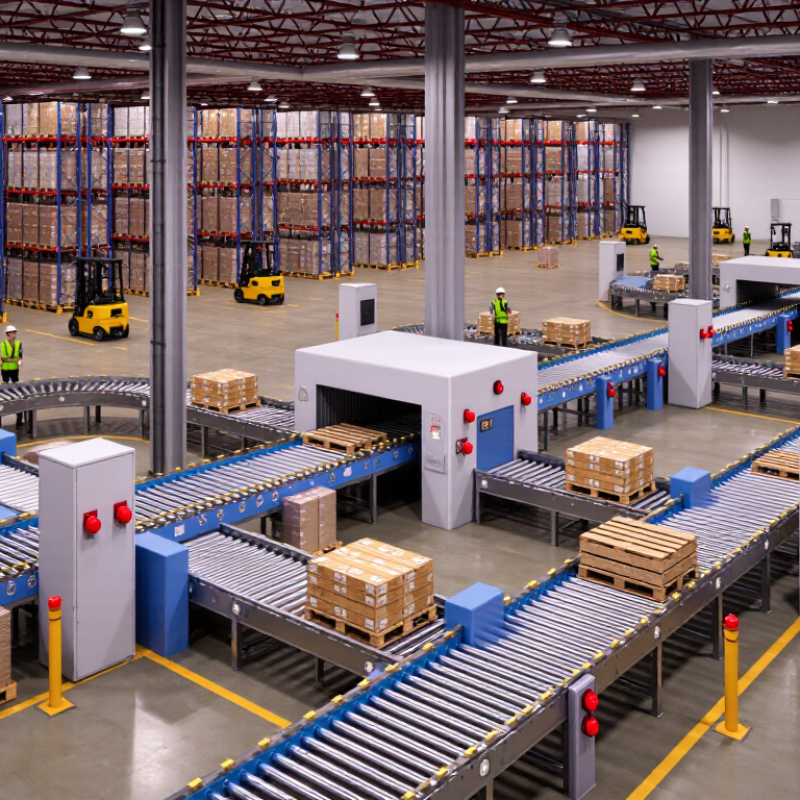
Pallet conveyors move loaded pallets between storage, production, inspection, and shipping areas. They reduce forklift traffic and create a more predictable material flow. Common designs include roller conveyors, chain conveyors, and powered turntables. Each suits different pallet weights, surfaces, and transfer distances.
A roller conveyor works well when pallets have strong, even runners underneath. Chain systems can handle heavier or less stable loads. In a working warehouse, sensors stop one pallet before it contacts another. Photoelectric switches, guarded pinch points, and emergency stops support safer operation. Control software can also track accumulation, routing, and delivery timing.
Good equipment selection begins with the pallet, not the catalog. Measure its length, width, weight, underside, and load balance. Check the busiest hour, not only the average shift. A conveyor may carry the stated load, yet fail when weight is concentrated near one corner. That detail matters. I have seen layouts appear efficient on paper, but small gaps created repeated jams. Allow space for cleaning, inspection, and manual recovery. Maintenance teams should access motors, sensors, chains, and rollers without dismantling nearby sections. Global buyers should also examine installation support, spare-part availability, documentation, and compliance with local safety requirements. A lower purchase price can become expensive when replacement parts arrive slowly. Performance claims deserve practical testing with real pallets and actual loads.
Global pallet conveyor buyers should evaluate manufacturers beyond catalog speed and attractive pricing. Proven project experience matters, especially with heavy, uneven, or mixed-size pallets. Ask for references from facilities with similar loads, temperatures, and operating hours. A capable engineering team should calculate load capacity, conveyor spacing, transfer points, and expected throughput. It should also explain guarding, emergency stops, noise levels, and maintenance access clearly.
Reliability depends on more than a strong frame. Review motor quality, control-system compatibility, spare-parts availability, and preventive-maintenance requirements. Request drawings, inspection records, test procedures, and documented quality controls. Factory acceptance testing can reveal tracking problems before shipment. Ask how the manufacturer handles installation support, operator training, warranty claims, and delays. Communication is a practical test. Slow or vague answers may signal future difficulties. No supplier is perfect. A missed detail in pallet dimensions can create expensive redesign work.
Tips: Ask for evidence. Compare total ownership costs, not only purchase prices. Confirm the conveyor’s performance with your actual pallet samples. Check whether local technicians can respond quickly. Examine welds, sensors, cable routing, and access panels during a factory visit when possible. One overlooked issue remains common: buyers often approve impressive demonstrations without testing repeated starts, stops, and loaded transfers. That decision deserves another review.
Leading pallet conveyor manufacturers differ mainly by technology, engineering depth, and market reach. Roller conveyors suit heavy pallets and steady warehouse movement. Chain conveyors handle uneven loads and cross-transfer points reliably. Modern suppliers may also integrate sensors, barcode readers, warehouse software, and automated guided vehicles. These features matter when a facility processes mixed pallet sizes or operates around the clock.
Manufacturers with broad market reach usually provide local installation partners, multilingual documentation, and accessible replacement parts. Check their experience with your pallet weight, floor layout, temperature range, and required throughput. Ask for safety records, factory testing procedures, and clear warranty terms. A polished demonstration is useful, but it does not replace performance data from a similar site. Some specifications remain unclear until commissioning.
Tips: Request a layout simulation before purchasing. Confirm motor availability in your region. Test emergency stops, photoelectric sensors, and accumulation logic with real pallets. A low quote may appear attractive, yet weaker controls can increase downtime later. I would also examine service response times, because a delayed sensor can stop an entire line. No system is perfect. Leave room for maintenance access and future expansion.
Top Pallet Conveyor Manufacturers for Global Buyers
Comparing Conveyor Designs, Customization, and Industry Applications
Pallet conveyor selection starts with load behavior, not catalog appearance. Chain conveyors handle heavy, uneven pallets well. Roller conveyors support smoother movement and easier accumulation. Belt systems protect fragile packaging, but they may require more cleaning and maintenance. Transfers, lifts, and turntables connect these designs when layouts include gaps or direction changes. A short site test can reveal problems that drawings miss.
Customization should match measurable operating conditions. Engineers usually review pallet size, weight, material, speed, temperature, and available floor space. Variable-speed drives can reduce impact at loading points. Sensors help prevent collisions, while guarding and emergency stops support safer operation. Controls should communicate with warehouse software through suitable industrial interfaces. However, excessive automation can increase training needs and spare-parts costs. Simpler is sometimes more reliable.
Different industries demand different conveyor priorities. Automotive plants often need robust chains for dense loads and repeated cycles. Food and beverage facilities may prefer corrosion-resistant frames and accessible cleaning zones. E-commerce warehouses require accurate accumulation, frequent starts, and flexible routing. Pharmaceutical operations typically need traceable movement and controlled environments. During supplier evaluations, buyers should request load-test records, maintenance schedules, and installation references. A polished specification can still hide weak after-sales support. That detail deserves careful questioning.
Top Pallet Conveyor Manufacturers for Global Buyers
Global buyers should evaluate pallet conveyor manufacturers beyond the purchase price. The 2024 MHI Annual Industry Report found that 83% of respondents planned to increase supply chain technology investment. This makes dependable automation a purchasing priority, not a luxury. Ask for documented load tests, dimensional tolerances, noise levels, and cycle-time results. A conveyor handling 1,000-kilogram pallets needs different engineering from a light-duty system. Request factory acceptance testing before shipment. Small alignment errors can become expensive stoppages.
Compliance must match the destination market. Request risk assessments, electrical schematics, guarding details, and emergency-stop validation. A quality certificate alone proves little. Check whether components and documentation support local installation and inspection requirements. The World Bank’s 2023 Logistics Performance Index measures customs, infrastructure, tracking, and timeliness. These factors affect delivery risk, even when the equipment itself is well built. Service terms should define response times, spare-parts availability, remote support, and technician training. Vague promises are not enough.
Tips: Compare total cost of ownership, not only the quotation. Include energy use, commissioning, software updates, spare parts, and predicted downtime. Ask for references from facilities with similar pallet weights and operating temperatures. Confirm warranty exclusions in writing. A cheaper system may be sensible, but I would question any quote missing integration and maintenance costs. The overlooked detail is often the costly one.
| Evaluation Dimension | Buyer-Facing Metric | Globally Relevant Benchmark or Requirement | Recommended Verification Evidence | Purchasing Significance |
|---|---|---|---|---|
| Pallet Compatibility | Supported pallet footprint and condition | Common international footprints include 1,200 × 800 mm and 1,200 × 1,000 mm. The design should also define acceptable pallet damage, bottom-board spacing, and skew tolerance. | Approved pallet drawings, load samples, dimensional tolerance records, and site acceptance test results | Prevents jams and reduces the risk that local pallet variations will require later modifications. |
| Load Capacity | Rated load per pallet and load distribution | The rating must be calculated for the heaviest pallet, the longest conveyor span, acceleration forces, transfer points, and any accumulation condition. Uniformly distributed loads and concentrated loads should be assessed separately. | Structural calculations, motor and gearbox data, load-testing records, and signed design assumptions | A clear load basis avoids premature wear, drive overload, and warranty disputes. |
| Throughput | Pallets per hour and accumulation performance | Capacity should be stated together with pallet pitch, conveyor speed, start-stop frequency, merge logic, and the required buffer length. Theoretical belt or roller speed alone is not a throughput guarantee. | Simulation results, cycle-time calculations, throughput test protocol, and factory acceptance test data | Makes supplier quotations comparable and exposes bottlenecks before installation. |
| Mechanical Quality | Frame rigidity, roller alignment, weld quality, and surface protection | The specification should identify steel grade or material specification, corrosion-protection method, allowable frame deflection, roller runout, and guarding requirements. | Material certificates, weld inspection records, dimensional inspection reports, coating or galvanizing documentation | Improves service life and reduces alignment problems in high-cycle applications. |
| Controls and Safety | Emergency stops, guarding, sensors, interlocks, and restart behavior | Safety-related control functions should be risk-assessed and designed according to applicable machinery-safety requirements, including ISO 13849-1 where relevant. Electrical equipment commonly references IEC 60204-1. | Risk assessment, safety-circuit validation, electrical schematics, functional test records, and user manuals | Supports safe operation and simplifies regulatory review in the destination market. |
| Regulatory Compliance | Market-specific conformity and documentation | For the European Economic Area, CE marking may apply under relevant legislation. Other destinations may require local electrical, machinery, workplace-safety, or electromagnetic-compatibility requirements. | Declaration of Conformity where applicable, technical file index, electrical test reports, and country-specific compliance checklist | Reduces customs, commissioning, and legal risks caused by incomplete conformity documentation. |
| Quality Management | Process control and corrective-action capability | ISO 9001 certification is a useful quality-management indicator, but it should not replace product-specific inspection, testing, and traceability requirements. | Valid certificate scope, internal inspection plan, nonconformance records, serial-number traceability, and audit results | Helps buyers assess repeatability across large projects and multiple production batches. |
| Energy and Operating Cost | Motor efficiency, control strategy, and idle consumption | Compare connected load, duty cycle, accumulation mode, variable-speed control, standby logic, and regenerative features where applicable. | Motor nameplate data, power-consumption measurements, duty-cycle assumptions, and lifecycle-cost calculation | A lower purchase price may not provide the lowest total cost over years of operation. |
| Service and Spare Parts | Response time, parts availability, and maintainability | The purchase agreement should define spare-parts lists, recommended stock, remote-support hours, escalation contacts, preventive-maintenance intervals, and target response times. | Service-level agreement, parts catalog, maintenance schedule, troubleshooting guides, and technician qualification records | Directly affects uptime, especially when the installation is far from the manufacturing location. |
| Integration Capability | Compatibility with warehouse-control and plant systems | The control specification should define PLC interfaces, network protocol, signal list, barcode or RFID interfaces, fault codes, data ownership, and cybersecurity responsibilities. | Interface-control document, I/O list, network architecture, software backup, FAT records, and integration test results | Limits commissioning delays and reduces dependence on undocumented proprietary settings. |
| Delivery and Installation | Lead time, packing method, installation scope, and acceptance milestones | The quotation should separate engineering, fabrication, factory testing, export packing, shipping, installation, commissioning, and site acceptance activities. | Detailed project schedule, packaging specification, shipping documents, installation method statement, FAT and SAT procedures | Clarifies delivery responsibility and prevents hidden logistics or commissioning costs. |
| Commercial Cost | Total landed cost and total cost of ownership | Compare equipment price, engineering, tooling, packaging, freight, duties, installation, training, spare parts, energy, maintenance, and software-related charges on the same scope basis. | Line-item quotation, Incoterms® rule, payment schedule, warranty terms, exclusions, lifecycle-cost model, and change-order procedure | Creates a fair comparison between suppliers and minimizes unexpected project expenditure. |
| Warranty and Acceptance | Warranty duration, performance guarantee, and defect resolution | Acceptance criteria should be measurable and include throughput, load handling, safety functions, availability assumptions, documentation completeness, and punch-list closure. | Contract warranty clause, FAT/SAT checklist, performance test results, defect log, and final handover dossier | Connects payment and warranty obligations to objectively verifiable system performance. |
Note: Technical benchmarks are procurement guidance only. Final conveyor ratings, safety measures, certifications, and installation requirements must be validated against the actual pallet, site conditions, applicable laws, and the completed engineering design.