Industries
Get direct access to our extensive portfolio of optical products and specialist technical expertise.
A Red Light Therapy Bed is a full-body wellness device that uses red and near-infrared light. Its panels usually surround the user while they lie comfortably on a padded surface. The light reaches the skin without ultraviolet radiation, tanning, or intense heat. Many people describe the session as calm, warm, and surprisingly uneventful.
Michael R. Hamblin, PhD, a widely cited photobiomodulation researcher, describes the principle simply: “Photobiomodulation is the use of light to stimulate biological processes.” In practical terms, specific wavelengths may interact with cellular structures and influence energy production. Research has explored possible benefits involving skin appearance, temporary muscle comfort, and recovery. However, results can differ between individuals, devices, and treatment schedules.
The technology is not magic.
A professional explanation must include uncertainty. Some commercial claims move faster than the evidence, especially when they promise dramatic or universal results. Device quality also matters. Wavelength, irradiance, treatment distance, exposure time, and eye protection can change the experience. A bright bed is not automatically a better bed.
This guide examines what a Red Light Therapy Bed does, how its light may work, and what users should realistically expect. It also considers practical details, including session length, comfort, safety precautions, and the limits of current research. The goal is not to oversell the treatment. It is to make the technology easier to understand before someone steps beneath the glowing panels.
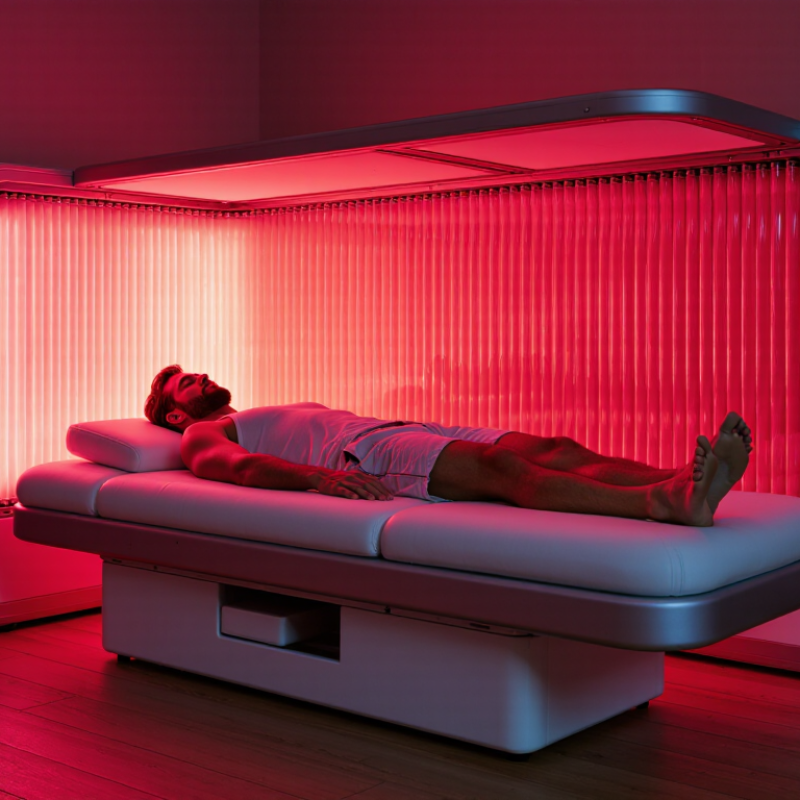
A red light therapy bed is a full-body photobiomodulation device. It uses rows of LEDs to expose the skin to red light and near-infrared light. Red wavelengths commonly sit near 630–660 nanometers, while near-infrared wavelengths often range from 810–850 nanometers. Red light mainly reaches surface tissues. Near-infrared light can travel deeper into soft tissue. Cells absorb this energy through mitochondrial structures, which may support ATP production and normal cellular repair processes.
The Global Wellness Institute reported that the wellness economy reached about $6.3 trillion in 2023. That growth reflects rising interest, not guaranteed results. A 2023 review in Photobiomodulation, Photomedicine, and Laser Surgery found potential benefits for skin appearance, pain, and recovery, but protocols differed widely. Treatment time, irradiance, distance, and wavelength all matter. More light is not automatically better. That part is often misunderstood.
Tips: Check the device’s wavelength, irradiance, and treatment distance before use. Follow the stated session time, and protect your eyes when instructions require it. Take clear photos under the same lighting. Changes can be subtle. People with photosensitive conditions or medication use should seek professional advice first. Results may vary, and some claims remain stronger than the available evidence.
A red light therapy bed is a reclining device that exposes much of the body to controlled light. Its main wavelengths are 630–660 nanometers red light and 810–850 nanometers near-infrared light. Red light is visible, while near-infrared light cannot be seen. Both can reach skin tissue, although near-infrared light generally penetrates more deeply.
These wavelengths may interact with cellular structures, including mitochondria, which produce energy for cells. Researchers are studying whether this process supports circulation, tissue repair, and normal inflammatory responses. Results can vary because studies use different doses, session times, and devices. More light is not automatically better. That point is easy to overlook.
Tips: Check the device’s measured wavelength range and irradiance, not just its marketing language. Wear recommended eye protection, especially during facial or full-body sessions. Keep sessions brief at first, and follow the manufacturer’s instructions. If you take light-sensitive medication or have a medical condition, ask a qualified healthcare professional before use. Skin warmth can occur, but pain or persistent redness deserves attention. Photosensitivity is uncommon, yet possible. Careful tracking helps: note session length, distance, skin reactions, and any changes over several weeks. Expecting instant results can make honest evaluation difficult.
A red light therapy bed uses panels of red and near-infrared light across the body. Its performance depends on dosimetry, not appearance. Irradiance measures delivered power, in watts per square centimetre. Fluence measures accumulated energy, in joules per square centimetre.
The calculation is simple: fluence equals irradiance multiplied by treatment time. At 0.05 W/cm², a 4–10 J/cm² dose requires about 80–200 seconds. At 0.10 W/cm², it requires 40–100 seconds. Distance, skin position, device calibration, and body curvature can change the real dose. A timer alone proves very little.
Photobiomodulation literature commonly investigates doses around 4–10 J/cm², although optimal ranges vary by tissue, wavelength, and purpose. The World Association for Photobiomodulation Therapy publishes application-specific dose guidance, while IEC 62471 addresses photobiological safety assessment for lamps and light systems. These sources support measurement-based decisions, not universal promises.
A practical session should record wavelength, irradiance at the skin, exposure time, and calculated fluence. Ask for calibration evidence. Treat marketing numbers carefully. A bed may display 10 J/cm², yet deliver less at the shoulders or lower legs. That uncertainty matters. More energy is not automatically better; excessive exposure may reduce usefulness, and research still has gaps. Practitioner supervision is sensible when skin conditions, medications, or light sensitivity are involved.
What Is a Red Light Therapy Bed and How Does It Work?
A red light therapy bed uses red and near-infrared light across large body areas. Its proposed mechanism is photobiomodulation, not heating. Photons enter skin cells and may interact with mitochondrial cytochrome c oxidase, a key enzyme in the respiratory chain. This interaction can influence electron transport and cellular energy production. Small changes matter.
Cytochrome c oxidase may respond by supporting ATP formation, nitric oxide signaling, and controlled reactive oxygen species. These signals can affect circulation and inflammatory pathways. Karu’s cellular research linked specific light wavelengths with mitochondrial responses, while Hamblin’s review described photobiomodulation as a dose-sensitive process (Karu et al., Photomedicine and Laser Surgery; Hamblin, AIMS Biophysics, 2016). The response is not simply “more light, better results.”
Professional dosage guidance from the World Association for Photobiomodulation Therapy commonly considers wavelength, irradiance, exposure time, and total fluence. In practice, bed devices may deliver different doses, even when their panels appear similar. A typical session can feel warm, but warmth does not prove mitochondrial activation. Light penetration also decreases with depth, especially through fat and dense tissue. The biology is not perfectly tidy. Human outcomes remain inconsistent across conditions, and laboratory mechanisms cannot guarantee personal results. That uncertainty matters when evaluating treatment claims.
A red light therapy bed uses low-intensity red and near-infrared light across much of the body. LEDs deliver measured irradiance, usually reported in milliwatts per square centimeter. Treatment time matters as much as brightness. A ten-minute session at 20 mW/cm² delivers 12 joules/cm². That calculation should appear in the technical file, not only in advertising.
IEC 62471 evaluates photobiological safety and places lamps into four risk groups, from exempt to higher-risk categories. The assessment considers wavelength, irradiance, exposure distance, and duration. Red light may present limited retinal risk, but near-infrared output remains invisible. Users cannot judge intensity by sight. Eye protection should match the tested spectrum, fit securely, and remain comfortable throughout the session. It is not automatically adequate because it looks dark.
FDA 510(k) summaries show that clearance generally supports substantial equivalence to a legally marketed device. It does not prove every wellness claim or guarantee results for every user. Responsible documentation should state the cleared indication, wavelength range, irradiance, dose, and contraindications. Independent testing can verify output at the user’s skin, where heat, distance, and body position change exposure. In practice, a bed can feel simple while its safety file is incomplete. I would question any device that provides glowing LEDs but no IEC 62471 report, eye-protection specification, or readable FDA claim language. Human responses also vary, and stronger light is not automatically better.
| Topic | Evidence-Based Information | Safety or Regulatory Significance |
|---|---|---|
| What a red light therapy bed is | A full-body photobiomodulation device that uses non-ionizing visible red light and, in some models, near-infrared light. The user lies or stands near multiple light-emitting sources. | It is not a tanning bed and should not be described as producing ultraviolet tanning radiation unless the device specifically includes another light source. |
| Common wavelength ranges | Visible red light is commonly described as approximately 620–700 nanometres (nm). Near-infrared light is generally longer than 700 nm; many photobiomodulation systems use selected wavelengths in the approximately 700–1,400 nm region. | Wavelength, irradiance, exposure duration, and distance all affect tissue dose and eye-safety assessment. A wavelength label alone does not establish safety or effectiveness. |
| How the light is thought to work | Photobiomodulation research proposes that certain light doses can influence cellular signaling, mitochondrial activity, blood-flow responses, and inflammatory pathways. Results vary by condition and treatment protocol. | Mechanistic findings do not automatically prove that a particular bed treats a disease. Clinical claims should be supported by appropriate human evidence. |
| IEC 62471 scope | IEC 62471 is a photobiological safety standard for lamps and lamp systems. It evaluates potential optical hazards to the eye and skin over specified wavelength ranges, including approximately 200–3,000 nm. | A meaningful safety assessment should consider the device’s measured optical output, viewing distance, exposure time, accessible emissions, and applicable risk group—not just the presence of an IEC 62471 reference. |
| IEC 62471 risk groups | The standard uses risk groups to characterize the potential hazard under defined exposure conditions. The classification depends on measured radiance or irradiance, spectrum, exposure duration, and distance. | A risk-group result is condition-specific. It should not be treated as a universal guarantee for every user, position, session length, or operating mode. |
| Eye protection | Eye protection requirements depend on wavelength, optical power, exposure duration, viewing geometry, and the device’s photobiological risk assessment. Red and near-infrared light may appear comfortable while still requiring exposure controls. | Follow the device instructions. Use correctly rated protective eyewear when required, avoid staring directly into intense sources, and obtain professional advice for eye disease, photosensitivity, or light-sensitive medication use. |
| Dose and treatment schedule | Optical dose is commonly expressed as energy density in joules per square centimetre (J/cm²), calculated from irradiance and exposure time. More exposure is not automatically better; biological responses can vary with dose. | Users should follow the supplied protocol and avoid extending sessions or reducing the recommended distance without appropriate safety data. |
| FDA device claims | In the United States, regulatory status depends on intended use and marketing claims. A device promoted for diagnosis, cure, mitigation, treatment, or prevention of disease may meet the definition of a medical device and may require an applicable FDA pathway. | “FDA registered,” “FDA listed,” or “FDA compliant” does not mean that the FDA approved the device’s effectiveness. Any clearance or authorization generally applies to a specific product, indication, and intended use. |
| Wellness versus medical wording | General wellness wording may describe appearance, relaxation, or temporary comfort. Disease-treatment claims require a substantially higher level of regulatory and clinical support. | Avoid assuming that a cosmetic or wellness product can treat pain, wounds, acne, hair loss, depression, or other medical conditions unless the specific claim is properly supported and authorized where required. |
| Potential adverse effects | Reported problems may include temporary warmth, redness, irritation, headache, eye discomfort, or symptom worsening. Risk can increase with excessive exposure or photosensitizing conditions and medications. | Stop use and seek medical advice for persistent pain, visual changes, significant skin reactions, or other concerning symptoms. Do not use light therapy as a replacement for prescribed care. |
| Information to verify before use | Check the exact wavelengths, irradiance at the intended distance, recommended session duration, IEC 62471 test information, eye-protection instructions, electrical safety information, contraindications, and the precise regulatory claims. | Transparent technical specifications and clear instructions are more useful than broad statements such as “medical grade,” “risk free,” or “FDA approved.” |
| Important: IEC 62471 addresses photobiological safety; it does not establish clinical effectiveness. FDA terminology and requirements depend on the device’s intended use and claims. Always follow the specific user instructions and consult a qualified healthcare professional when medical conditions, eye concerns, or photosensitizing medicines are involved. | ||