Why Choose Planetary Gearboxes for Your Industrial Needs?
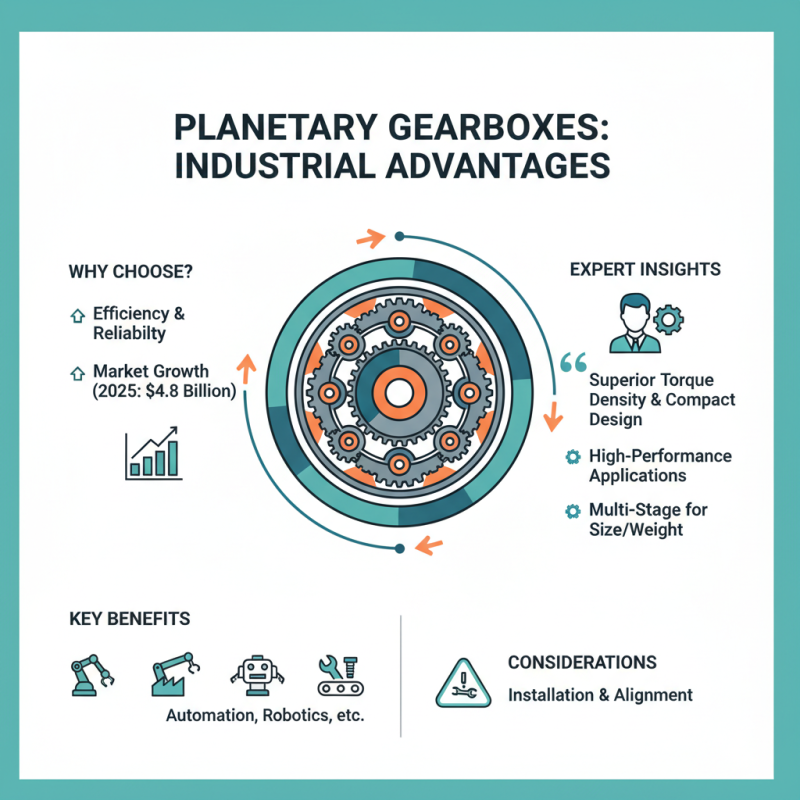
The increasing demand for efficiency and reliability in industrial operations drives the choice of Planetary Gearboxes. According to a recent report by Markets and Markets, the global planetary gearbox market is anticipated to reach $4.8 billion by 2025, growing at a CAGR of 7.5%. Such growth underscores the significance of these gearboxes in modern manufacturing processes.
Dr. James Harper, a leading expert in gearbox technology, emphasizes the crucial role of planetary gearboxes: “They offer superior torque density and compact design, essential for high-performance applications.” The multi-stage gear configuration provides increased torque while minimizing size and weight. This design makes Planetary Gearboxes indispensable in automation, robotics, and other industrial sectors.
Yet, while the benefits are clear, challenges remain. Not every application may leverage these advantages fully. Misalignment or improper installation can lead to premature failure. Industry professionals must weigh these factors carefully. As choices increase, understanding the unique positioning of Planetary Gearboxes is vital.
Advantages of Planetary Gearboxes in Industrial Applications
When it comes to industrial applications, planetary gearboxes shine for many reasons. They provide high torque density, which makes them ideal for compact spaces. Their design consists of multiple gears, allowing for smoother power transmission. This results in lower noise levels during operation. In highly demanding environments, planetary gearboxes excel in efficiency and reliability. They can handle heavy loads without compromising performance.
Tips: Always consider the load requirements of your application. Be mindful of how gear ratios affect torque output. Proper alignment is crucial to the longevity of the gearbox.
Another advantage lies in their versatility. Different configurations suit various uses, from robotics to renewable energy systems. They can easily adapt to changing industrial demands. However, the complexity of installation may pose challenges. Not all setups will benefit from planetary gearboxes. Understanding your system's needs is vital for optimal performance.
Tips: Regular maintenance checks can prevent unexpected breakdowns. Evaluate the operating environment to extend gearbox life. Ensure that you’re using suitable lubricants for your specific gear design.
Key Features of Planetary Gearboxes for Enhanced Performance
Planetary gearboxes stand out in industrial applications due to their unique design and efficiency. These gearboxes feature a central sun gear surrounded by multiple planet gears and a surrounding ring gear. This configuration allows for high torque transmission and compact size. This space-saving design is crucial in many sectors where equipment footprint matters.
Durability is another key feature. Planetary gearboxes can handle heavy loads and operate under tough conditions. Their ability to distribute stress evenly across gears enhances their lifespan. However, selecting the right gearbox requires careful consideration. Not all applications need high-speed ratios. Some industries prioritize torque over speed. It’s essential to evaluate specific needs for optimal performance.
The versatility of planetary gearboxes is impressive. From robotics to manufacturing, they offer reliable solutions. However, potential drawbacks exist. Their complexity might lead to higher maintenance requirements. Users must understand the balance between efficiency and maintenance. Making informed choices ensures longevity and reliability in industrial machinery.
Performance Comparison of Planetary Gearboxes
Comparison of Planetary Gearboxes with Other Gear Types
When considering gear types for industrial needs, planetary gearboxes stand out for multiple reasons. Their design enables efficient torque distribution across multiple gears, resulting in high efficiency and compactness. Unlike traditional gear types, such as spur or helical gears, planetary gearboxes are better at handling high-load conditions. This makes them ideal for applications requiring durability and reliability.
Tips: Assess your application’s torque requirements before selecting a gearbox. This helps determine the best fit for your needs.
Planetary gearboxes also provide a higher gear ratio in a compact form. In contrast, other gear types often require more space to achieve similar ratios. This space-saving feature leads to reduced overall machinery footprint. However, the complexity of planetary designs can lead to intricate maintenance processes that some operators may not be prepared for.
Tips: Always consult with a gear specialist when modifying or maintaining gear systems. Their expertise can prevent costly errors and downtime.
In essence, while planetary gearboxes offer unique advantages, they come with a set of challenges. The decision to use them should involve careful consideration of both their benefits and potential drawbacks in specific applications.
Why Choose Planetary Gearboxes for Your Industrial Needs? - Comparison of Planetary Gearboxes with Other Gear Types
| Gear Type | Torque Capacity | Efficiency | Size | Cost | Application Examples |
| Planetary Gearbox | High | Up to 95% | Compact | Moderate | Robotics, Conveyors |
| Spur Gear | Moderate | 75-90% | Varied | Low | Automotive, Machinery |
| Helical Gear | Moderate to High | 85-95% | Larger | Higher | Industrial Drives |
| Worm Gear | Low to Moderate | 50-85% | Compact | Moderate | Gear reducers, Lifts |
Applications of Planetary Gearboxes in Different Industries
Planetary gearboxes are increasingly integral across various industrial sectors. Their compact design allows for high torque output while maintaining a lightweight structure. These features make them ideal for applications in the automotive and robotics industries. A report by Research and Markets highlights that the global planetary gear market is expected to grow by 6.4% from 2023 to 2028, driven by their efficiency and versatility.
In automotive applications, planetary gearboxes are widely used in automatic transmissions. Their ability to handle high load conditions enhances vehicle performance and fuel efficiency. Similarly, in robotics, these gearboxes facilitate precise control of movements. The demand in these areas demonstrates the importance of selecting the right gear solutions for operational excellence.
Tip: Always consider the application requirements before selecting a planetary gearbox. Understand load conditions, speed, and torque needs. Ensuring compatibility with your equipment is essential for optimal performance.
In the manufacturing sector, planetary gearboxes enhance performance in conveyors and mixers. However, the efficiency can sometimes be hampered by inadequate maintenance. Regular inspection and proper lubrication are crucial for sustaining performance levels. A small oversight can lead to significant downtime, impacting productivity.
Maintenance Considerations for Optimal Performance of Gearboxes
Maintenance is crucial for the optimal performance of planetary gearboxes in industrial settings. Regular inspections help ensure efficiency and longevity. Check for wear and tear in gears and bearings. This can prevent unexpected breakdowns and costly repairs. Lubrication is another essential aspect. The right lubricant helps reduce friction and heat, enhancing gearbox efficiency. If the lubricant is old or contaminated, it can lead to serious issues.
Pay attention to noise and vibration levels during operation. Unusual sounds might indicate mechanical problems. It’s important to address these signs early. Additionally, temperature monitoring is vital. Overheating can lead to failure. Regular cleaning of the gearbox and surrounding area can prevent dust and debris buildup. This is especially important in industrial environments with high levels of contaminants.
Finally, keep detailed maintenance records. This helps in tracking performance over time. It allows for better decision-making regarding repairs and replacements. Regular training for staff on maintenance best practices also improves reliability. Reflection on past maintenance efforts is key to ongoing success. Enhancements can be made based on observations and data.